Showing posts with label assessment. Show all posts

Friday, November 22, 2013

The Farming [Thing]

I called this a Project. It's not.  It's more of a problem-y kind of performance task learning opportunity assessment of  for of for? learning that hits close to home.  Literally.  We live in a huge agricultural area and kids don't know what an acre is.  Anything that gives students a chance to wrestle with the fact that a piece of land can't have dimensions of 20 acres x 20 acres, is a win.  Anything that allows me to answer the question "What's an acre-foot?" by doing this, is a win.

In this project  problem's first iteration, I was focused on the skills of equation writing, line graphing and solving mixture and work problems.

In the second iteration, I was less focused on the skills and more interested in having students explain what each component of an equation represented, why we'd want that equation and how graphing inequalities made sense.  We got to discuss why understanding the problem makes sense--kids tried to hire crews to prune cotton.  For you city-slickers out there--you don't prune cotton. It doesn't grow on trees.  Students had to sign up via Google form to interview with me as they finished a task.  I did something north of 175 interviews for one class that year.

This year, I've changed it a bit more.  They are no longer tasks, they're constraints.  There are fewer of them and they don't specifically tell kids what to do.  Before, I told them to create inequalities and graph them. Now, I'm removing some of the scaffold.  They get to decide what tools they want to use.  Before, I did this project after we had done systems, mixture and work problems.  This time, we have only done systems. They're going to have to work through the mixture/work stuff.

That's been the highlight--the mixture problems.  I have a few students who went straight for that constraint and have been on a mission to figure out how to make sense of it.

Today, one boy asked, "Mr. Cox, how accurate to I need to be?  I'm accurate to the trillionth, but I can't get it to be exactly 36%."

I said, "How accurate do you think you need to be?  We're killing weeds, not sending someone to space."

So, with all that, here's the updated version complete with dynamic answer key.

Friday, November 1, 2013

I'm Bringing Multiple Choice Back

So here's the idea:

One problem with multiple paths to solution.  Students connect as many skills as they can to the problem.  I listed eight possible skills two of which wouldn't necessarily apply to the problem. Students had to assess themselves on the skills they demonstrated. 

Question of the day:  "Mr. Cox, is it possible to use all of these skills?"

Answer to Question of the day:  "It's possible that some of the skills don't apply."

For this first iteration, I used the standard Ticket Problem. 

Below are samples of student work. 

As an exercise for the reader:

1) What are your thoughts on this process?  
2) How did each student do?

Let me know in the comments. 

Student A


Student B


Student C

Student D

Friday, October 18, 2013

The Student Rubric

We are currently working on a performance task where students have to gather data, apply a line of best fit, determine a rate and then make a prediction.  It's been a task to help students shift their thinking from right/wrong to more/less.  In other words, I don't want them to see their understanding as binary--I get it; I don't get it.  I want them to see their understanding as something that falls on a continuum.

When doing something like finding a line of best fit, I think it's less important to discuss what the line looks like and more important to discuss why a particular line is best. This leads us to the descriptors we've been using to discuss both sides of the same coin:

Concept and Precision

5: Strong concept; Precise

4: Strong concept; Somewhat precise

3: Problem with concept; Somewhat precise

2: Problem with concept; Lacks precision

1: No attempt

Through a few discussions with different classes, the top three descriptors have evolved into something like this.

5: Precise answer with precise method

4: Estimate backed by reason

3: Estimate

Then I walked by a student and noticed the self-assessment she was doing.


How's that for kid friendly?

Monday, November 8, 2010

Video Assessment

I mentioned a while back that I thought a Flip camera may be a pretty decent assessment tool. Today, I had one group having a great discussion about distilling the process for finding a perpendicular bisector into a few steps. I grabbed the Flip and sat down with them. Forgive me if you can't read their steps very well, I'm still working out the kinks.


Perpendicular Bisector from David Cox on Vimeo.

I think I see some real potential here. Kids can record themselves and then we can go to After Effects and add some stills of their work. I don't know, maybe I'm getting ahead of myself. Feedback welcome necessary, please.

Wednesday, April 21, 2010

Taxonomy

In the age of accountability, we have become increasingly skill based. That's not necessarily a bad thing. But I've noticed that with each benchmark, common formative assessment or state test we give, teachers have the tendency to focus on the product and not on the process (ie. let's give them the skills and pass 'em down the hall). I encourage inquiry with my students. I allow them to fall down the rabbit holes we encounter. In fact, I've been known to scrap the lesson for the benefit of a good question a student has asked. Most of us do. But the one thing that I've noticed as well is that even my grades have become increasingly skill based. I've been wondering how to assess the problem solving stuff. A colleague clarified some of this for me the other day at lunch. We were discussing the idea that once a student has been shown how to work a problem, it then becomes an exercise and no longer carries with it the attributes that allow a student to be a problem solver. He shared with me that he noticed how his students would ask for an example every time he tried to get them to do some problem solving and how that just didn't sit right with him. It doesn't sit right because the student is trying to take a problem and apply the teacher's algorithm to it. If the example is close enough, he can plug and chug, get an answer and we'll be none the wiser.
If we can get our kids to be proficient with the skills, show the ability to put them together in a problem solving situation and occasionally surprise the pants off of us with one of those "wow-look-what-you-did" moments, I'd say we'd call it a good year. This continuum can be tricky, though. The more time a student spends wrestling with the skills, the more time we need to be there for support. As a student becomes proficient with the skills, we can let go a little more and become a facilitator. I think that many teachers get frustrated because they hear of these great things that are going on in the classrooms of others and wonder why it won't work in their room. Well, maybe it will. But maybe it's because we've put the kid on a mountain bike before he can ride the tricycle. Can't expect a kid who is buried in skill acquisition to blow the doors off you with his inquiry methods--which isn't to say that the student doesn't have the ability to inquire, it may just need some dusting off.

At the end of the year, I'd like my students to be able to duplicate skills, apply skills and create something using the skills.


Duplication aka: Skills

Description: Here's the tool. Here's how you use the tool. Show me you know how to use the tool. Do it again, I don't believe you. One more time, just to be sure. Alright, you are now allowed to use this tool whenever you see fit.

Essential question: Can you use the tool?

How: How these skills are taught may vary. Direct instruction, investigations, Socratic method...I don't care. At the end of the day, the student is acquiring a skill. The more of the lifting they can do themselves while acquiring these skills the better because they are preparing themselves for the next steps of application and creation. Asking questions is going to be the teacher's best friend.

Assessment: Skills tests in the form of multiple choice or free response. Students are free to reassess at any time during the year as their understanding of the skill changes. This is why I don't have a problem with posting study guides and online examples. There are no surprises on my skills tests. Each different skill corresponds to a different assignment in the gradebook. I'm not really too concerned with how they arrive at the answer as the focus is on the product.

We don't give finals in our middle school, but next year I am going to give a summative test every 6 weeks or so that cover all skills to date. For example, the first assessment will cover skills 1-8, the next will cover skills 1-19, and we will end with a cumulative skills test covering skills 1-39.

Application aka: Problem Solving

Description: I want you now to build something. Choose which tools you will use. Make sure your final product looks like *this*.

Essential question: Can you put more than one tool together to do something you haven't done before?

How: Give students a problem that uses skills they already have and walk away--sometimes literally. In this process, I think the students should generate more of the questions--although prodding them along with a question now and then isn't a bad thing. Be careful though, I have found that sometimes I have to take a physical posture of audience member by actually sitting down and looking at the floor in order to cease being the primary resource.

Assessment: This can be in the form of a teacher created project, short assessments requiring students to demonstrate their thinking or even an observation during class. I've thought about including higher level problems in my skills tests and students who successfully solve the problems earn a 5, but then I run into the problem of reassessment and context. The skills test will often give a context to the problem that we may not want the student to have. Reassessment on this will be different because it isn't about the particular problem, but the process by which the student attacks the problem. I'd argue that the skills necessary are irrelevant as long as the students being assessed possess the skills necessary to solve the problem. If this is a written test, it should contain problems the students have never seen before. So I'm thinking about a "Problem solving" weighted category or maybe a weighted standard that is dynamic the same way the other standards are.

Creation aka: Projects

Description: Now, what would you like to build? Design it. Plan it. Build it. Reflect on what you built. Did you choose the right tools? What would you do differently next time?

Essential question: Do you understand your set of tools well enough to recognize what types of things you can and can't do?

How: Student generated projects. My 7th graders are working on a relations project where they choose two variables to compare, gather data and investigate the relationship. Final product will include multiple representations of their data and a presentation using the medium of their choice. (I'll blog about it after we finish state testing.) I really like what Shawn Cornally is doing with his physics kids. If anyone can help me figure out how to do this with some precocious middle school math students, write a book and I'll buy it.

Assessment: The project is the assessment.

Creation > Application > Duplication

Success in any of the higher levels validates the lower levels. For example: If a student can demonstrate problem solving ability by writing an equation and solving it, then not only does this affect the problem solving score, but it validates the equation solving skill. If a student can create her own project, then I'd say problem solving looks pretty strong as do any skills that were present in the project.

The Book
The worst part of all this is that we gotta give it a grade. How do we arrive at a final mark? This year, I left my grades uncalculated until the marking period opened and once grades were submitted, they went back to being uncalculated. I wanted parents and students to focus on the score for each skill and not the "averages." To arrive at a final mark for the students, we look at our rubric the same way one would view a grade point average.

4.5-5.0 = A
4.0-4.4 = B
3.0-3.9 = C
2.0-2.0 = D
< 2.0 = F

This was simple because there were no weighted categories. But now with the fact I want to focus on problem solving, projects and include summative tests, I need to figure out how this should look in the grade book.

Questions

  • Where does problem solving show up in your gradebook?

  • Should the scores on the summative tests have their own category in the gradebook or should each skill be treated like it's own reassessment?

  • Have I lost my mind?


      Friday, April 16, 2010

      Brain Dump

      Problems vs. Exercises
      Today, I threw this problem up in front of my 8th graders and they looked like they'd seen a ghost.


      I like this problem because today it was an opportunity for them to show their problem solving skills.  They have all the tools they need to solve this problem, but they need to figure out which tool to use and when. 
      • find a common denominator
      • add fractions
      • divide fractions by inverting and multiplying 
      • reducing fractions
      Tomorrow it won't be a problem solving opportunity.  Tomorrow it becomes an exercise.  It may be a complex exercise, but it's an exercise nonetheless. 

      Now that they've seen this problem and know how to work it, I have to view it differently.  It has to carry less weight if it finds its way on an assessment because now the problem provides its own context for them. 

      Assessment
      I think that in order for a student to be considered an expert, she needs to demonstrate the ability to do something with the tools beyond what she's been shown.  When students encounter a problem on a test that makes them say, "but he didn't show us how to do that in class," that's a good thing.

      It's true that standards based grading in math can be more than just reporting specific snippets of content knowledge(there ya go Matt) It has to be more than just skills because I don't have a problem posting my skills online with examples of how to perform the skill.  I don't mind showing them what they need to know and them assessing them on that content.  I do mind stopping there.  The skills are the floor, not the ceiling. 

      How we best help students realize they need these skills is a great conversation that I'm looking forward to seeing fleshed out.  But I think that there is also a need to discuss not only what exactly we need to assess but how.  I'm not of the opinion that we should assess behaviors like organization, responsibility, etc.  I do think that we should assess skills that may be consistent throughout our content area but not limited to our specific course.

      This leads me back to the assessment question I asked in my previous post. How do I assess this ability to know when and how to put the tools together?


      Do I treat it as a skill/standard and allow the score to change as students demonstrate their ability throughout the year?

      Is it enough to involve my students in activities that promote problem solving and simply grade them on what I observe in class?

      Does it show up in a summative assessment testing multiple skills?  If so, do the other "skills" that are on the test tip the student off as to the context of the problem at hand?

      Do we use projects for students to demonstrate the ability to put a string of skills together in order to create their own meaning? 

      Alright, brain's empty.  Time to go home.

      Thursday, April 8, 2010

      ExamView and Summative Assessments

      I use the phrase summative assessment very loosely because as long as my class and I have some time together, they can continue to improve upon weaknesses.  But with most of my assessments covering one skill at a time, there may be a need for assessments that check for retainment of concepts (ie. benchmarks, finals, etc.)  Now that I have created assessments for each skill, I want a way to create assessments that combine multiple skills and, ultimately, culminate into and end-of-course-test.  Fortunately, I don't have to re-create the wheel. 

      The process is actually pretty simple. 

      Export Skills Tests to an ExamView Question Bank
      Simply take an existing test and export as a question bank.  This will allow you to use these questions in the creation of future tests. 

      Choose Method for Selecting Questions
      For this test, I chose to select questions while viewing.  I have a good idea of which skills/standards I want on the test, so I want to be able to look at the question before selecting it. 

      Switch Banks to Select Questions
      Now that I can view the questions, I just need to be able to switch from one question bank to another. 

      And...

      Done!
      Did I mention, that I'm kind of a fan of this thing?

      Wednesday, March 31, 2010

      The Process

      I currently use an augmented version of our school's assessment system. All of our teachers are using standards/skill based grading allowing for re-assessment, but because of the technology I have available in my classroom (ie. class set of laptops), I can do some things that my colleagues can't.

      Skills List
      The system all starts with the skills list. This isn't news to you because if you're reading this blog, you're most likely reading dy/dan as well. Our district made the move towards standards based instruction a few years ago with some of our campuses throwing out the textbook pacing and teaching a standard at a time. We have decided to go one further and break up the thicker standards into smaller more manageable skills. Each student gets a skill list where they keep track of their progress. They also have a "playlist" where they set goals for the week.


      Online Examples/Study Guides
      I spent the better part of the last two years populating our school website with examples. They have been organized by text section, state standard and soon, I will have them done by skill. Many of these were recorded during class and are the result of student generated questions. I hope to upgrade these examples so they are a little cleaner. The study guides are simply .html exports of the ExamView tests I have created. In hindsight, I think I'll go back and make all the study guides short answer as opposed to multiple choice. I have found that too many student won't show work otherwise.

      Ideally, I would like the skills to be just that, skills. I want my students to access these study guides and examples on their time which would free up class time for projects and problem solving. Based on conversations I've had with my 7th graders, they are realizing the power of being able to access these resources at their convenience which gives me confidence that a classroom inversion is more likely next year. It's tough to have them unlearn certain behaviors, but because my classes are really a two year program, I see much growth the second year.

      CFA
      Pre-test, Common Formative Assessment, Test #1...
      Call it what you want, it's basically the first test I give my students which sets the bar for them in the grade book. This semester, these tests have been administered solely through the ExamView Test Manager. Students access the tests through the EV Player and go to work. Once a student finishes the test, they get immediate feedback on each question. They know what they answered correctly and what they missed before they leave class. Skill lists are updated on the spot. Students have been taking screenshots of their feedback sheets and save them to their folder on the server. These screenshots double as proof of their completion of the assessment as well as a set of practice problems they can do as they prepare for re-assessment.


      Re-assessment
      I set up all of the tests so that students can access them only once. This prevents them from simply memorizing the answers from a test and then doing it again. That's why dynamic questions are a must. I have a set of post tests ready to go--it takes just a click of the button to calculate new values for the test. On most tests, I will make some of the questions short answer so students have to do some explaining. There is not an equation editor available for students while they take the test so I have to be careful which question types I use for free response.

      In order for a student to take a re-assessment they have to do a couple of things.

      • Demonstrate they recognize the mistakes they've made and show me they know how to fix them.
      • Sign up. (h/t to Kate for the form idea)
      I've tried to make all of my expectations as transparent as possible. There really are no surprises when it comes to test time. Here's the floor of what I expect you to know, now show me. It's been interesting talking to parents about this because they like the system but can't believe it's this simple.

      Work in Progress
      I just learned that I can also attach a link to a video or audio file in the test player. This will allow me to use these media as prompts for future test questions. I'm not exactly sure how I'll use it but I can see myself doing a screencast of myself doing a problem incorrectly and having students pick out the mistake. I can also see showing a clip of a projectile and asking students to find it's highest point.


      My plan for next year is to develop a set of projects for students to do that incorporate a group of skills. Students will only be able to work on the project once they have demonstrated proficiency in that given skill set. My farming project may act as a true semester project this way. But instead of waiting until the end of the semester to give it, I will give it to them at the beginning of the year and say they have until the end of the semester to finish it.

      Anyone up for developing some projects?

      Friday, February 19, 2010

      And Yet Another Reason

      Many of my students have really had a tough time with solving equations with absolute value on both sides. If the test happens to be multiple choice, then they just work backwards by plugging the answer choices into the original equations. I found a way to combat that and still be able to administer the test via our network.

      Short answers are allowed and the Test Player has a space for students to explain their process and submit a numeric answer. All I have to do is manually enter the number of points a student earned on each problem.


      Once students have completed an exam, they receive a feedback sheet explaining what they missed and why. The rationale for each problem has been created for most of the problems in any test generator. However, since I've been creating many of the problems myself, I have to build the rationale into the problem using the algorithm definitions used in the problem itself.
      So this:


      Becomes this:

      This becomes very convenient when it comes to online study guides as students and parents can go through the problems, see if they are correct and then, if a problem was missed, see why it was missed.


      Tuesday, February 9, 2010

      OK. I Really, Really Like It

      Love may be too strong of a word. But now that the good folks in the IT department got me set up with ExamView player. Now I can administer tests via our local network. It's really a pretty simple process.


      Publish existing test to LAN:


      Decide who has access to the test:
      Give it a name and password:


      Scramble the questions. You can also set the algorithm values so each student actually gets a different test.


      Decide if you want them to be able to check their answers as they go as well as the type of feedback they will receive once they have finished the test.


      From there it is simply a matter of students going into a shared folder and opening up the ExamView player. They have to know where you have saved the test, but other than that, it's pretty smooth sailing.


      Once students have finished the test, simply ask for the results and thar ya go!


      So far, I am using only multiple choice tests. I have mixed feelings about this. However, now that I can write the questions myself and program the misconceptions into the distractors, I'm not mad at myself for doing it. I will start playing around with using numeric responses and see how it goes.

      All in all, I really like the idea of being able to provide different versions of the same test depending on who is taking it and when. It also makes for a super easy re-assessment tool.

      Friday, January 29, 2010

      I Love Me Some ExamView

      I spent the last two days on school business building a set of common formative assessments in ExamView that are aligned to my department's skills list for our algebra and pre-algebra classes. Many of the questions are dynamic which means that for any given question type, multiple versions of the question can be created by the click of a button. As I was looking through the question banks, I realized that there were some skills that didn't have questions that fit what we will be trying to assess. Solution? Build it yourself.

      The process is a bit tedious at first, but I was able to use previously made questions to figure out how to build a simple question regarding slope.

      Step 1: Define your algorithms.

      Step 2 : Create a graph using pre-defined variables.

      Step 3: Define the distractors.

      Yeah, gotta say I love this feature. Finding questions with good distractors is tough at best. But if you decide on an algorithm based on common misconceptions, you're good to go. In this problem, I decided the common misconceptions for students calculating slope based on a graph were:
      • Using Run/Rise instead of Rise/Run
      • Confusing negative with positive slope
      • Confusing the y-intercept with the slope
      Of course, there may be some discussion on what the best misconceptions would be, but for the sake of practicing, those are what I went with.
      Step 4: Decide how many of these type of question you want in your assessment.

      I'm glad that I don't have to build all of these from scratch, but I like the fact that filling in the holes isn't too tough.

      Monday, October 26, 2009

      Our Grading System

      Standards Based Instruction

      We decided a few years ago that the sequence of our texts don't really work for us.  As a result, we began teaching one standard at a time. We have taken our state standards set up a sequence and pace  in a way that makes sense to us.  Some of the standards we have broken down into specific skills and these skills are what make up our gradebook.

      Common Formative Assessment

      Once we have done our initial classroom instruction, we give a common multiple choice assessment.  This assessment is graded on a 1-4 rubric.  A students next step is based on how well they do on the assessment which is a pretty fair cross-section of the different problems a student may be expect to do on the given standard.  We determine the initial score based on the percentage of problems they get correct.  85-100% = 4, 70-84% = 3, 55-69% = 2 and below 55% = 1. 

      Less Than Proficient

      The level of understand a student demonstrates determines what happens next.  If a student scores a 1 or 2, he will do a series of activities that may include defining basic terms and demonstrating pre-requisite skills.  Once finished with these activities, the student will then take the problems that were missed on the CFA and not only correct them, but explain what went wrong (verbally or in writing) and how to work the problem correctly.  Students who score a 3 on the initial assessment are just required to make the necessary corrections with explanation.  Once the corrections have been made, the student is then given a re-assessment and the new score replaces the old score in the gradebook. 

      Proficient

      Although  students may get 100% of the problems correct on the initial assessment, we still give them a 4.  Our reasoning is that the multiple choice test doesn't allow our students to demonstrate understanding that goes beyond classroom instruction, but it does allow them to show proficient understanding.  Students who demonstrate proficient understanding on the assessment are given the opportunity to turn the 4 into a 5 by choosing from two categories of activities.  Examples of activities may be creating a mini lesson, peer tutoring or some other project agreed upon by teacher and student.  The second activity is some sort of writing assignment that may require the student to explain the process or describe what skills a student may need in order to be successful with this standard.  Once a student has completed these activities and has shown the ability to explain his work the score in the gradebook will be turned into a 5. 

      Strengths

      At this point, I can say that the strengths of this system are:

      • Students grade is based on what they understand and not a mere accumulation of points.

      • Students are allowed to re-assess and new understanding replaces old understanding in the gradebook.

      • Students seem to understand where they are having trouble and what skills they need to remediate.

      • Learning has become a conversation between teacher and student because in order to re-assess, student needs to articulate previous misunderstanding and current understanding.

      • Students have a choice on when to re-assess.  They can work at their own pace.

      • Students also have some choice on which activities to do in order to demonstrate understanding.

      • The dross has burned off the grade.  Students' grades are based on what they understand rather than things like effort,  homework or extra credit.


      Weaknesses

      • Students have to take more ownership of their learning which means they have to un-learn some bad habits.  Not sure that it is a weakness in our system specifically or an indictment of the educational system in general.

      • Teachers are having to re-think classroom management when students are working on different activities.

      • We are having to decide if some of our standards actually lend themselves to "advanced" work or if later standards are the advanced version of some previous standards.

      • Need to develop more advanced activities for students to do while working towards a 5. We allow for students to create their own activity as long as it has been agreed upon by the teacher, however many students don't know what to do with that kind of freedom. 


      Questions

      • What's the best way to take a series of 1's, 2's, 3's, 4's and 5's that are based on levels of understanding and turn them into a letter grade? Do you use mean, median or mode? 

      • If we go with some sort of average from 1-5, what percentage do you use for an A, B, C, D or F? Currently we are going with average where > 4.5 = A, > 4.0 = B, > 3.0 = C, > 2.0 = D and <2.0 = F.


      Adaptation for the Advanced Class

      Because my classes are advanced, I have to adapt this system to suit my students' needs.  Basically, I am using the standards as the "basic skills" for my class.  I have a posted a series of mathcasts and study guides on each standard and the students are expected to view the online examples and do the problems in the study guide prior to taking the pretest.  If a student scores above 90% on the initial assessment, there is no other work to be done on the standard--they receive a 5.  Students who score below  90%, need to correct their errors, explain to me that they understand why they made their mistakes and how to fix them.  Once I am convinced that they have truly corrected their errors, I give them a second assessment and the new score replaces the old one. 

      My reason for allowing students to earn a 5 right off the bat is that 90% of our classwork is problem solving that uses the standards as the jumping off point.  Students in my 8th grade class receive two grades.  They are all enrolled in an algebra class as well as a geometry class.  We treat the algebra class as the "grade level" basic skills class and the geometry class is the "advanced" class.  The geometry we are doing is analytical so students are having to use the algebra at a much higher level...so I'm ok with not making them jump through hoops in the algebra class. 

      Note: My department is awesome.  I truly loved my math department at my previous school and it was really tough to leave them.  However, I couldn't imagine working with a group of teachers more willing to try new things.  We have pretty good discussions in our department meetings and there is plenty push back.  But at the end of the day, we are all trying to find the best way to educate our students.

      Monday, October 5, 2009

      Who Gets It?

      Here's the problem:

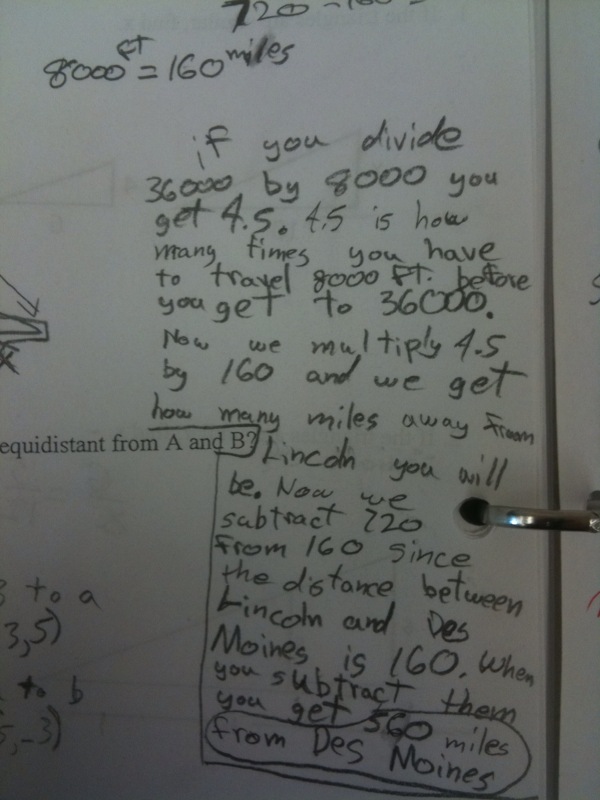
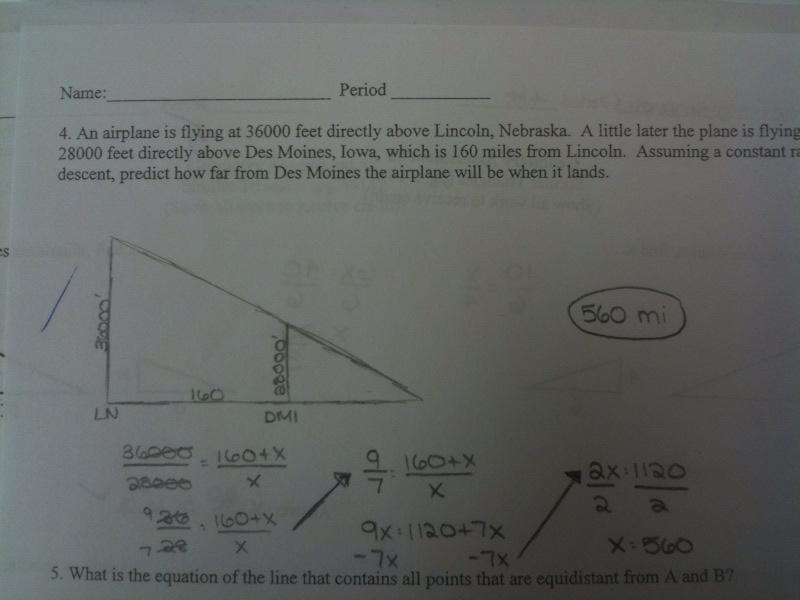
      An airplane is flying at 36,000 feet directly above Lincoln, Nebraska.  A little later the plane is flying at 28,000 feet directly above Des Moines, Iowa, which is 160 miles from Lincoln.  Assuming a constant rate of descent, predict how far from Des Moines the airplane will be when it lands. [1]

      Question: Which student demonstrates better understanding? Why?

      Student A


      u1

      Student B


      u2

      Student C


      u4

      Student D


      u5


      [1] Problem courtesy of Phillips Exeter Academy.  Hat Tip: Alison Blank

      Wednesday, September 23, 2009

      What's in a Grade?

      "How many pages does it have to be?"

      "Is this going to count?"

      "How many points is it worth?"

      "What can I do to bring my grade up?"

      "Can I do extra credit?"

      You've all heard these before, right?  I have said for a long time that the worst part of teaching is grading.  It's a tough situation because somehow we have to put a number on it.  If we don't grade, then "kids won't do it."  But because of grades, we often get students who are looking for the least amount of work for the maximum grade. I hate that about this job.  I want to ask questions that lead them to ask questions and have class end up with a giant group hug where we all walk away realizing that we may not know the answers, but man, we sure questioned the heck out of it. 

      We have done a lot of work on our campus to try to get kids to go beyond the curriculum.  We just became the first middle school in our county to reach 800 in API.  Yeah, hold the applause.  It's based on a standardized test which we all know don't mean nuthin' when it comes to having kids actually think.  But truth be known, this means that principals from our area will come calling asking, "what are you guys doing?"  They may be disappointed when they come to see the dog and pony show but end up seeing a staff that is doing their darndest to get kids to question and speak/write complete thoughts.  You see, these principals are asking the wrong question.  It isn't about what we are doing.  It's about what the kids are doing. 

      Apparently our students are doing something right, though.  They are developing a reputation in high school for being "Sequoia kids" who sit in the front row, ask questions and, at times, challenge an occasional teacher to step up their game.  Fantastic!  But how do you grade that?  How do you grade a kid who has learned how to learn?  Last I checked, that isn't in my state framework.  There's no standard for that.  Which brings me back to grades.

      How do you quantify learning? Why is 90% average the accepted norm for a kid who really gets it?  90% of what? Is this student truly advanced, or did she take a bunch of tests full of a bunch of basic questions and get 90% of them correct? 

      So tell me, what does a kid have to do to earn an A in your class? What are you doing to ensure that the grade actually means something and isn't just verification that a student jumped through all the right hoops?

      Friday, September 11, 2009

      Monologue to Dialogue

      "When you add a positive integer with a negative integer, how do you know if your answer is positive or negative?"

       "Well if the negative number is bigger, then the answer is going to negative.  If the positive number is bigger, then the answer is positive."

      "Aren't all positive numbers bigger than negative numbers?"

      "Well, yeah.  But if you take the sign off the negative and it's bigger than the positive, then the answer will be negative."

      "Why are  you taking the sign off the negative number?  What rule allows you to do that?"

      "Uhh..."

      "I know that I can give you 20 addition problems and you will probably get all 20 right, but I want you to explain to me why this works the way it does.  Come talk to me when you think you have an answer."

      *10 minutes goes by*

      "Alright, I think I've got it.  If the negative number is farther down the number line than the positive number, then the answer is going to be negative."

      "Farther down the number line?"

      "Yeah, it's more negative than the positive number is positive."

      "How do you know that?"

      "It's farther from zero?"

      "Oh, what do we call that when a number is farther from zero than another number?"

      "Uhh..."

      *5 minutes later*

      "ABSOLUTE VALUE!.  If  the negative number has a greater absolute value, then the answer is negative.  If the positive number has the greater absolute value, then the answer is positive."

      "That is correct young grasshopper.  You have done well.  You may now enter into the realm of proficiency."

      I have had this conversation about 10 times over the last few days.  Our current system has students take a common formative assessment (CFA)which is very closely aligned to our state's standards.  It's a multiple choice test that has questions that look an awful lot like the same questions they'll be seeing in April when we take the CST test.  Based on their score, they have a set of activities to do before they can re-assess.  Re-assessment may look like the conversation above.  I think I am really going to like this system because it allows for dialogue between teacher and student.  I have the opportunity to ask them about the why and actually tie it to their grade.  The benefit to this is that students have choice in how they demonstrate their proficiency the second time.  The first time, it's a multiple choice test.  However, the second time may be written, oral or heck, they may even draw a picture. One of the best things about this is that the students are taking more ownership of their learning because they have to direct some of the activities.  They actually have choice.  And that's empowering.  They aren't waiting for me to give them another hoop to jump through. 

      The parents are coming along slowly.  Many of them didn't understand how their student could score 100% on the CFA and yet the score in the grade book shows up as 80%.  Last night was Back to School Night and I got the chance to explain that each standards' assessment is two parts.  The first part is multiple choice and the second part depends on the student.  Once they realized that their child's grade quits improving when they quit trying, I think they got it. 

      It'd be nice if we could focus less on the grade and more on learning, but...

      ...baby steps.

      Wednesday, April 8, 2009

      The Easter Egg Hunt

      Every nine weeks my district gives benchmark exams covering approximately one-third of the standards that have been deemed "essential."  Many teachers feel the need to do a bunch of last minute cramming and do intensive review.  For the most part, I see the benchmark as a speedbump; one of those things that I have to do.  I mean, I we already have department CFAs (common formative assessments) that we use to re-direct our instruction, so I pretty much already know where my kids stand.  So for the last benchmark of the year, I decided to change up the review.

      I made up a practice test covering the standards that would be assessed, uploaded it to voicethread and had students sign up to create a mathcast for specific problems.  However, this time they were looking for a fastball up and in and I gave them a change away. I asked a few students to do the problems incorrectly (of course, first they had to demonstrate to me that they could do the problem right.) Once everyone had added their comments to the Voicethread, I assigned the Easter Egg Hunt--Which ones are wrong and why? I think I really like this activity. Students not only have to work out each problem themselves, but they have to view another's work critically. I would love to hear what you think.