One of the things that I have learned over the years is to let go of any preconceptions I have about how a problem should be solved. I have methods I prefer, but my students need to develop their own. Never has this been more obvious than it was today.
We are beginning to play around with non-linear functions and so I gave my class the following problem:
You're going to build a garden and need to build a fence around it. If you have 120' of fencing, how would you set it up in order to have the biggest garden?
...or something like that.
I didn't specify rectangle although I figured most kids would default to that. I didn't mention the barn in the back of the property that could be used as one of the sides. I just kept the prompt as simple as possible so I could see where they took it.
Many assumed a square right off the bat. And one group felt pretty ambitious and looked up some shapes in their school planner only to settle on the typical decagon. (Good luck calculating the area of that one, fellas.)
So, I'm walking around and seeing groups all proud of themselves by defining x as one side and y as the other and they're arguing about whether 2x + 2y = 120 or x + y = 60 is the better equation. I ask a few questions like, "so how will that equation help you determine the largest garden" to which they reply, "we'll find the maximum."
"Mmm-kay," I say as I mutter to myself, "I'll be back..."
Then I walk up to a group of three boys who usually push the envelope when it comes to creative problem solving and I see the equation x + y = 60. I think to myself, "oh, no not you too."
Then I look a little closer and I see this other thing they're working on.
xy > 900
I double take.
"Wait, what?"
Before any of them even address my incredulous look, one of them says, "let's go put it in GeoGebra."
"So how'd you come up with that?"
"Well we figured that x + y = 60 tells us how much fencing we have. And since a square would give us 900 ft2, we want to know if there is an area out there that's greater than 900."
"Uh, yeah. That's, uh, yeah, that's exactly how I'd do it."
Not really. This is what I really said.
These kids used a system. Not in a million years would I have ever considered using a system to solve this problem and three 13 year-olds set me straight.
Man, I love this job.
Wednesday, February 1, 2012
Wednesday, January 25, 2012
Something's Wrong Here
Search Institute [1] has compiled a list of 40 Developmental Assets that may protect youth from high-risk behaviors while promoting positive attitudes and behaviors. I don't know how valid the research is, but I found the list to be interesting and the data to be fascinating.
Each of the 40 assets remain the same for each developmental stage while the application of assets change based on the age of the child. They're worth a look.
I took a particular interest as I have a son in each of these developmental stages. Suffice it to say, I have some reading to do.
When I first saw this chart, I thought, "Man, I gotta get my kids 31 of these assets."
But then, when I saw this chart I thought, "Holy, crap. We're doing something really wrong."
Figure it out in the comments, will ya?
[1] I have no idea if this is even a credible organization. I learned about this today at a meeting I attended and it was the one thing that didn't make me want to stab myself in the eye with a pencil.
Friday, December 16, 2011
All I Really Need to Know About Teaching I Learned From...
Mike Krzyzewski:
That's all.
“The truth is that many people set rules to keep from making decisions. Not me. I don’t want to be a manager or a dictator. I want to be a leader—and leadership is ongoing, adjustable, flexible, and dynamic. As such, leaders have to maintain a certain amount of discretion.”Look, it doesn't matter if we are talking about lesson design, assessment (formative/summative or whateverative), reporting, feedback or any other thing you can get yourself riled up about. The bottom line is that leaders--decision makers-- will find a way to be successful. They'll find a way to be successful because they realize that anything worth doing is about relationships. And relationships are dynamic. Relationships are messy. They're frustrating and they sure as heck don't come in a box. If you're looking for a program, system or formula to guarantee success for yourself or your students, STOP! It doesn't exist!
That's all.
Monday, December 5, 2011
Iron Sharpens Iron
Based on the feedback I've received in the comments and on Twitter, I have an updated version of this applet. Linda has also created a screencast that will probably prove to be way more cogent than my attempt at describing the process.
Thanks to @jk_herbert, @mrhodotnet, @MrPicc112, @mrautomatic and @mathhombre for the suggestions on Twitter.
Updated version addresses the following:
Thanks to @jk_herbert, @mrhodotnet, @MrPicc112, @mrautomatic and @mathhombre for the suggestions on Twitter.
Updated version addresses the following:
- Writing equation given slope and y-intercept places less cognitive demand on a student than writing the equation based on the graph. Levels 3 and 4 have been switched.
- Points and answers can't be changed after answer has been submitted.
- A running total has been added so student and teacher can view overall performance.
- Correct answer shown once answer is submitted giving immediate feedback to students on all levels.
There were also a couple of suggestions that were already embedded in the applet. There is a "reset" and "go to next level" button that can be accessed in the object properties. Double clicking on the applet should open it in a separate window which will allow you to save as well as make any changes you'd like.
Updated Applet
Update (12/6/11): Here is a version for student practice that includes both the "Reset" and "Next Level" buttons.
Saturday, December 3, 2011
GeoGebra: Leveled Applets
This stuff is crazy. We can actually make leveled applets that allow students to move on only after they've been successful with the previous level. I saw this applet the other day and was blown away. The applet itself is pretty simple, but the fact that it requires students to complete a specified number of exercises perfectly before moving on is the part that really interests me. The problem is that the thing is in German and there are a bunch of unnecessary steps. So, looking through the construction protocol proved to be fruitless. I'm pretty sure the guy who built it is way smarter than I am, so I'll try to simplify this the best I can.
Keeping track of student success pretty much requires three things.
True or False
Conditions must be set to determine whether the student's answer agrees with the target answer. This part made my head hurt. Having different levels made setting the conditions tough at first, but once I got a feel for what I was doing, the work started to flow.
Let's take a look at my level 1 problem.
In order for a level 1 problem to be considered correct, two conditions had to be met:
1. The line graphed by the student (h) had to be the same as the line generated by the applet (e).
2. The "Check Answer" button had to be clicked. The button was tied to boolean value g.
I entered the conditions for each problem type's correctness into the GGB spreadsheet and this what was entered into cell C2:
=If[e ≟ h ∧ g, true, false]
Each subsequent cell was used for the next level. (ie. C2 -> Level 1, C3-> Level 2, etc.)
Each individual condition for correctness was tied to a global correct boolean value named AnswerCorrect.
The condition for AnswerCorrect to be true is below.
If[C2 ≟ true ∧ ActualLevel ≟ 1 ∨ C3 ≟ true ∧ ActualLevel ≟ 2 ∨ C4 ≟ true ∧ ActualLevel ≟ 3 ∨ C5 ≟ true ∧ ActualLevel ≟ 4 ∨ C6 ≟ true ∧ ActualLevel ≟ 5 ∨ C7 ≟ true ∧ ActualLevel ≟ 6 ∨ C8 ≟ true ∧ ActualLevel ≟ 7, true, false]
The blue text represents the condition for a Level 1 problem.
Buttons
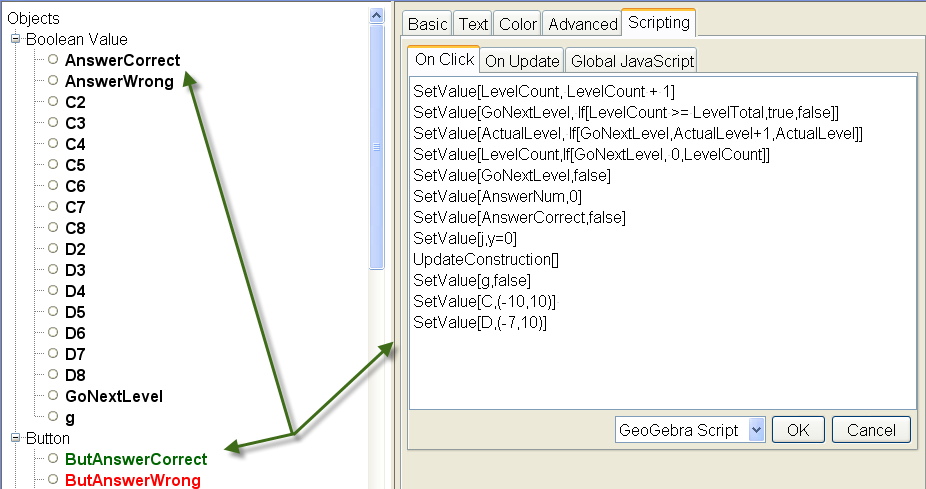
The AnswerCorrect and AnswerWrong booleans were tied to two buttons: ButAnswerCorrect and ButAnswerWrong. These show up with the basic condition under the advanced tab.
Scripts
This is where the magic happens. I'm still learning how to use the scripts, but this is where the levels advance, construction is reset and a new problem is generated. Both buttons have scripts, but the ButAnswerCorrect button is the most complex. These scripts can be used as a template for future applets. This is a good thing because there is no way I could create this on my own.
The applet I created is here. Double click the applet to open it in a GeoGebra window. You can then save it and play around with making your own.
I'd really appreciate feedback on this. If you have any questions, leave them in the comments and I'll do my best to answer them.
Big thanks to Linda for helping me weed through the junk on this.
Thursday, December 1, 2011
The Timeline of Awesome
Friday August 12, 2011
Kate poses a great problem.
Thursday, November 17, 2011
Dan asks a great question.
To which I responded something like, "yeah, prolly, but it'd take a bunch of brute force."
Saturday, November 19, 2011
I forward it to the GeoGebra Forum.
This flow of information absolutely amazes me. I mean, I loved the question after Kate posted it. In fact, I immediately created an applet and had used the problem with my advanced class early in the first quarter. They struggled a bit with it, but then when Dan asked about highlighting the squares and doing some of the counting, things changed.
I consider myself to be a little better than average when using GeoGebra, but Raymond is a freaking Jedi. Take a look at his stuff. He takes an applet that I thought would require a number of tedious steps and bangs it out using 6 steps--and within 24 hours. That's ridiculous.
The applet is here.
Kate poses a great problem.
Thursday, November 17, 2011
Dan asks a great question.
To which I responded something like, "yeah, prolly, but it'd take a bunch of brute force."
Saturday, November 19, 2011
I forward it to the GeoGebra Forum.
Sunday, November 20, 2011
Raymond responds.
This flow of information absolutely amazes me. I mean, I loved the question after Kate posted it. In fact, I immediately created an applet and had used the problem with my advanced class early in the first quarter. They struggled a bit with it, but then when Dan asked about highlighting the squares and doing some of the counting, things changed.
I consider myself to be a little better than average when using GeoGebra, but Raymond is a freaking Jedi. Take a look at his stuff. He takes an applet that I thought would require a number of tedious steps and bangs it out using 6 steps--and within 24 hours. That's ridiculous.
The applet is here.
Monday, November 28, 2011
Mixed Up Mixture Problems
A former student of mine (and future math teacher) just posted this problem on Facebook:
I've never been a big fan of 8th grade students having to work through mixture problems, but maybe that has to do with the way I've taught it.
Every year I would come up with a new way to encourage students to set up equations to solve these problems but we'd always end up with some variation of this:
And for my advanced classes, that was fine. They already knew how to solve systems of equations and it just became another jumpable (yeah, that's a new word. Deal with it.) hoop.
It never set well with me.
This year, it kinda pisses me off. I've got kids who are able to think, but this kind of abstraction just kills them. It may seem intuitive to freaks like us, but for most kids, it's just a ridiculous application of an already ridiculous skill.
Enter proportions.
We live in the agricultural capital of the world. People mix stuff here all the time--and they don't use systems of equations to do it. They use common-freakin'-sense.
Mira.
Step 1
Step 4
Step 5
Sit back and relax while the otherlosers diligent students are using systems of equations to solve this disaster challenging problem that includes not only rigor but relevance.
I find this not only easier for students to do, but it appeals to a skill (proportional reasoning) that they may actually use 10 years from now as opposed to a skill (systems of equations) that they will use for about however long it takes to pass the test.
Question
How do I introduce this so that it appeals to my students' intuition in a way that keeps it from being just another trick they learn?
Applet is available for download or online use here.
Soybean meal is 16% protein and cornmeal is 8% protein. How many lbs. of each should be added to get a 320 lb mix that is 14% protein?
I've never been a big fan of 8th grade students having to work through mixture problems, but maybe that has to do with the way I've taught it.
Every year I would come up with a new way to encourage students to set up equations to solve these problems but we'd always end up with some variation of this:
Let x = lb of cornmeal
Let y = lb of soybean meal
x + y = 320
.08x + .16y = .14(320)
Solve for x and y.
And for my advanced classes, that was fine. They already knew how to solve systems of equations and it just became another jumpable (yeah, that's a new word. Deal with it.) hoop.
It never set well with me.
This year, it kinda pisses me off. I've got kids who are able to think, but this kind of abstraction just kills them. It may seem intuitive to freaks like us, but for most kids, it's just a ridiculous application of an already ridiculous skill.
Enter proportions.
We live in the agricultural capital of the world. People mix stuff here all the time--and they don't use systems of equations to do it. They use common-freakin'-sense.
Mira.
Step 1
Step 2
Step 3
Step 4
Step 5
Sit back and relax while the other
I find this not only easier for students to do, but it appeals to a skill (proportional reasoning) that they may actually use 10 years from now as opposed to a skill (systems of equations) that they will use for about however long it takes to pass the test.
Question
How do I introduce this so that it appeals to my students' intuition in a way that keeps it from being just another trick they learn?
Applet is available for download or online use here.
Subscribe to:
Posts (Atom)