Friday, December 16, 2011

All I Really Need to Know About Teaching I Learned From...

Mike Krzyzewski: 
“The truth is that many people set rules to keep from making decisions. Not me. I don’t want to be a manager or a dictator. I want to be a leader—and leadership is ongoing, adjustable, flexible, and dynamic. As such, leaders have to maintain a certain amount of discretion.”
Look, it doesn't matter if we are talking about lesson design, assessment (formative/summative or whateverative), reporting, feedback or any other thing you can get yourself riled up about.  The bottom line is that leaders--decision makers-- will find a way to be successful.  They'll find a way to be successful because they realize that anything worth doing is about relationships. And relationships are dynamic. Relationships are messy.  They're frustrating and they sure as heck don't come in a box.   If you're looking for a program, system or formula to guarantee success for yourself or your students, STOP!  It doesn't exist!

That's all.

Monday, December 5, 2011

Iron Sharpens Iron

Based on the feedback I've received in the comments and on Twitter, I have an updated version of this applet.  Linda has also created a screencast that will probably prove to be way more cogent than my attempt at describing the process.


Thanks to @jk_herbert, @mrhodotnet, @MrPicc112, @mrautomatic and @mathhombre for the suggestions on Twitter.

Updated version addresses the following:

  • Writing equation given slope and y-intercept places less cognitive demand on a student than writing the equation based on the graph. Levels 3 and 4 have been switched. 
  • Points and answers can't be changed after answer has been submitted.  
  • A running total has been added so student and teacher can view overall performance.  
  • Correct answer shown once answer is submitted giving immediate feedback to students on all levels.
There were also a couple of suggestions that were already embedded in the applet.  There is a "reset" and "go to next level" button that can be accessed in the object properties.  Double clicking on the applet should open it in a separate window which will allow you to save as well as make any changes you'd like.  

Updated Applet

Update (12/6/11): Here is a version for student practice that includes both the "Reset" and "Next Level" buttons.  

Saturday, December 3, 2011

GeoGebra: Leveled Applets

This stuff is crazy.  We can actually make leveled applets that allow students to move on only after they've been successful with the previous level.  I saw this applet the other day and was blown away.  The applet itself is pretty simple, but the fact that it requires students to complete a specified number of exercises perfectly before moving on is the part that really interests me.  The problem is that the thing is in German and there are a bunch of unnecessary steps.  So, looking through the construction protocol proved to be fruitless.  I'm pretty sure the guy who built it is way smarter than I am, so I'll try to simplify this the best I can.

Keeping track of student success pretty much requires three things. 

True or False

Conditions must be set to determine whether the student's answer agrees with the target answer.  This part made my head hurt.  Having different levels made setting the conditions tough at first, but once I got a feel for what I was doing, the work started to flow. 

Let's take a look at my level 1 problem.  

In order for a level 1 problem to be considered correct, two conditions had to be met:

1.  The line graphed by the student (h) had to be the same as the line generated by the applet (e). 
2.  The "Check Answer" button had to be clicked.  The button was tied to boolean value g.  

I entered the conditions for each problem type's correctness into the GGB spreadsheet and this what was entered into cell C2:
=If[e ≟ h ∧ g, true, false]

Each subsequent cell was used for the next level.  (ie.  C2 -> Level 1, C3-> Level 2, etc.)

Each individual condition for correctness was tied to a global correct boolean value named AnswerCorrect.
The condition for AnswerCorrect to be true is below.   

If[C2 ≟ true ∧ ActualLevel ≟ 1 ∨ C3 ≟ true ∧ ActualLevel ≟ 2 ∨ C4 ≟ true ∧ ActualLevel ≟ 3 ∨ C5 ≟ true ∧ ActualLevel ≟ 4 ∨ C6 ≟ true ∧ ActualLevel ≟ 5 ∨ C7 ≟ true ∧ ActualLevel ≟ 6 ∨ C8 ≟ true ∧ ActualLevel ≟ 7, true, false]

The blue text represents the condition for a Level 1 problem.  

Buttons

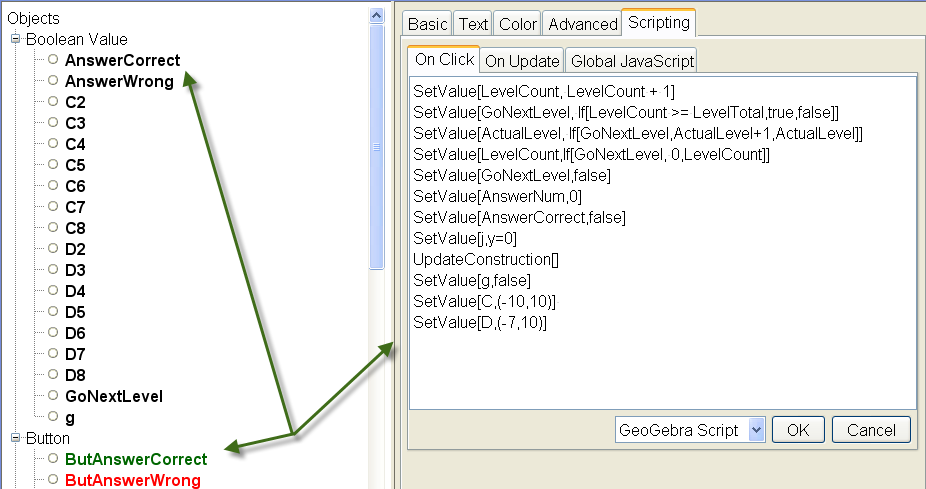
The AnswerCorrect and AnswerWrong booleans were tied to two buttons:  ButAnswerCorrect and ButAnswerWrong.  These show up with the basic condition under the advanced tab.  


Scripts
This is where the magic happens.  I'm still learning how to use the scripts, but this is where the levels advance, construction is reset and a new problem is generated.  Both buttons have scripts, but the ButAnswerCorrect button is the most complex.  These scripts can be used as a template for future applets.  This is a good thing because there is no way I could create this on my own.  


The applet I created is here.  Double click the applet to open it in a GeoGebra window.  You can then save it and play around with making your own.  

I'd really appreciate feedback on this.  If you have any questions, leave them in the comments and I'll do my best to answer them.  

Big thanks to Linda for helping me weed through the junk on this.  

Thursday, December 1, 2011

The Timeline of Awesome

Friday August 12, 2011

Kate poses a great problem.


Thursday, November 17, 2011

Dan asks a great question.


To which I responded something like, "yeah, prolly, but it'd take a bunch of brute force."


Saturday, November 19, 2011

I forward it to the GeoGebra Forum.


Sunday, November 20, 2011

Raymond responds.  


This flow of information absolutely amazes me.  I mean, I loved the question after Kate posted it.  In fact, I immediately created an applet and had used the problem with my advanced class early in the first quarter.  They struggled a bit with it, but then when Dan asked about highlighting the squares and doing some of the counting, things changed.

I consider myself to be a little better than average when using GeoGebra, but Raymond is a freaking Jedi. Take a look at his stuff.  He takes an applet that I thought would require a number of tedious steps and bangs it out using 6 steps--and within 24 hours.  That's ridiculous.

The applet is here.

Monday, November 28, 2011

Mixed Up Mixture Problems

A former student of mine (and future math teacher) just posted this problem on Facebook:

Soybean meal is 16% protein and cornmeal is 8% protein. How many lbs. of each should be added to get a 320 lb mix that is 14% protein?

I've never been a big fan of 8th grade students having to work through mixture problems, but maybe that has to do with the way I've taught it.  

Every year I would come up with a new way to encourage students to set up equations to solve these problems but we'd always end up with some variation of this:

Let x = lb of cornmeal
Let y = lb of soybean meal

  x + y = 320
.08x + .16y = .14(320)

Solve for x and y. 

And for my advanced classes, that was fine.  They already knew how to solve systems of equations and it just became another jumpable (yeah, that's a new word. Deal with it.) hoop.

It never set well with me.

This year, it kinda pisses me off.  I've got kids who are able to think, but this kind of abstraction just kills them.  It may seem intuitive to freaks like us, but for most kids, it's just a ridiculous application of an already ridiculous skill.

Enter proportions.

We live in the agricultural capital of the world.  People mix stuff here all the time--and they don't use systems of equations to do it.  They use common-freakin'-sense.

Mira.

 Step 1

 Step 2

Step 3


Step 4


 Step 5
Sit back and relax while the other losers diligent students are using systems of equations to solve this disaster challenging problem that includes not only rigor but relevance.

I find this not only easier for students to do, but it appeals to a skill (proportional reasoning) that they may actually use 10 years from now as opposed to a skill (systems of equations) that they will use for about however long it takes to pass the test.  


Question
How do I introduce this so that it appeals to my students' intuition  in a way that keeps it from being just another trick they learn?

Applet is available for download or online use here.

Thursday, October 20, 2011

This is Gonna Hurt

These kids aren't dumb.  But they think they are.  What's dumb is the way math has been done to them.  I didn't think so before.  I do now.

I made a commitment to do a few things differently this year.

Consistent Format
I've created a lesson template in SmartNotebook that is really quite simple.  Each file contains lessons one week at a time (even though I may only lesson plan one day at a time).  Files are named Week1, Week2, etc and slides are named Day1, Day2, etc.  Each day contains a slide for the Opener, Number Talk, Lesson for the Day, Homework Assignment and Exit Slip.  Any handouts, links or any other resources I need for the week are attached to the notebook file.  I've linked the previous day's homework slide to the current day's opener slide--mostly because I have a tendency to forget to talk about homework.  Another cool feature I've started to utilize is the ability to link to these resources from within the actual Smart slides. Now, I can access the web, applet or any other resource with just a click on the slide.

This has been really good for me because it's allowed me to really focus on the content of the activity which ends up paying dividends for the students as well.  This makes the design a non issue as I'm just replacing old with new and everything has it's place.  Next year it will be nice as well because my resources will all be aggregated.

Opener
I've always been a believer in having something for students to do at the start of the period but having things structured has helped me be more focused on my daily first impression.  These problems usually contain a review problem, some sort of pattern recognition problem and a maybe random fact involving numbers that I re-word so students have to make an educated guess.

Number Talk
I read about these in What's Math Got To Do With It and it immediately clicked.  I've been wanting to help kids with their basic numeracy and tried to deal with it as it came up.  Having a daily Number Talk has embedded it into my lessons.  This has paid off greatly in the first few weeks of the semester.  Metacognition is one of the bonus words in the faculty meeting bingo game and it gets thrown around like LMNOP in a pre-school class.  We think we know what it means, but really have no idea.  Metacognition isn't something you can talk about, it's something you have to be about. (h/t @jybuell)  A Number Talk is all about Metacognition.  I'm sure there could me more done with it than what I'm doing, but so far, so good.  It's a travesty that so many kids haven't learned to decompose and recompose numbers.  It's almost like I've had to give them permission to do so.  And there's a positive correlation between kids who struggle and kids who don't know how to break numbers apart and put them back together.  These kids are what we've begun to call "Stackers."  They want to mentally stack the numbers they are adding or multiplying and work the standard algorithms mentally which is the most difficulty way to do mental math.

This activity has "win" written all over it.  Not only do kids have to think about their thinking, but they get a chance to discuss it with others in a pretty non-threatening way.  I can already see the culture of the classroom changing.  I still have kids who are resistant because they are painfully afraid to share their thinking, but more are jumping on board than not.

Context, Context, Context
I've made a conscious effort to introduce everything via some sort of problem solving context. These contexts are sometimes application problems but, more often than not, they have been in the form of some sort of problem that gives students the opportunity to identify a pattern and use multiple representations to describe the pattern.  I started this very early because I want them to realize that words, pictures, tables, equations and graphs are just different ways to tell the same story.  I'm finding that kids who have scored very low on standardized tests have been very successful in taking a pattern and generalizing as well as graphing with not much trouble at all (which just further demonstrates that it's not the kids failing math, it's the math failing the kids).  I've also found that it's much easier to differentiate when you have students engaged in an activity than it is when you're in the middle of a lecture--news flash, right?  I'll go into more detail about the actual activities I've had students do in a future post.  But, suffice it to say, I'm convinced that these kids can do math.

Things That Need Work
I've been spoiled over the past five years.  The kids I've had come through my class have been extremely mature and hard working.  I would still have kids who would lose focus and say and do things they shouldn't, but the overall direction of the class has always been pretty easy to maintain.  But again, that mostly has to do with the fact that the advanced kids usually have parents up in their grill about anything less than an A.

First quarter just ended and, while we are still having our ups and downs, I can see some adjustments I need to make.

I have to be more mindful of the timing of things.  I'm still having trouble determining how long an activity should take.  As a result, I'm either running out of time or expecting things to go longer than they actually do. It's a different type of planning for sure.

I can't expect all these kids to be mathematicians. Yet. Yesterday, I had one of my advanced kids discover the point-slope form of a linear equation.  All I did was give the class a point and a slope and asked them to figure out a way to show me the equation.  It was beautiful.  And messy.  And it was all his.  In fact, instead of using (x1,y1), we used (c, a) for the given point for no other reason than those were the kid's initials.  I can't just drop a problem on my other two classes and get out of the way.  I can however, offer opportunities for them to engage in math in real ways.

It's not their fault. I'm all about kids taking responsibility, but I have to remember that they have been forced been trained learned to wait for directions.  I have to help them unlearn this learned helplessness.  But I also have to be gentle when pointing it out.  I'm not very subtle at times and I think that's done more to hurt the progress of some kids than help.

I have to find a balance between context and abstraction. Even my struggling kids can take a context and have a decent discussion on how the graph helps tell the story.  But if I give them the exact same equation to graph without any context, I get a bunch of I've-never-seen-this-before looks. This isn't a matter of not being able to do it; it's just a matter of recognizing it when there isn't a context.


I'm probably not going to fix all these things before the year's out, but that's ok...there's always tomorrow.



Wednesday, October 5, 2011

The Un-Lecture

Pretest

3x - 5y = 15

x intercept:  ______

y intercept:  ______


Results

0% correct


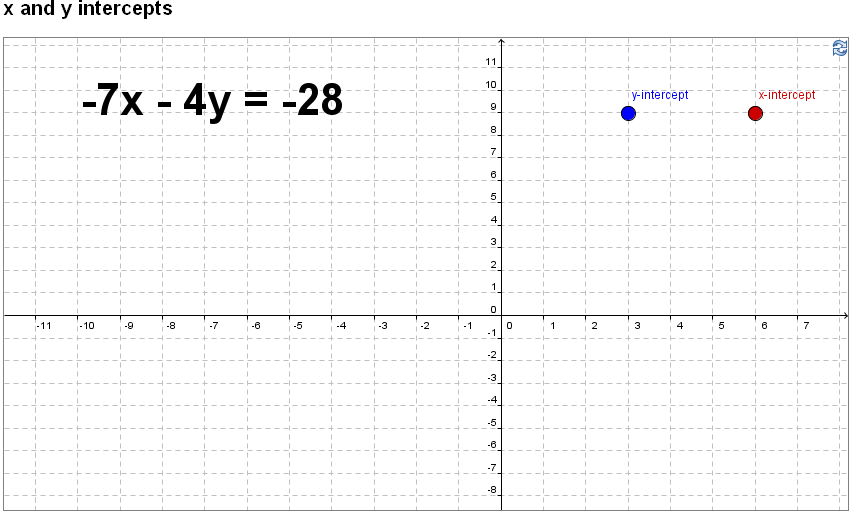
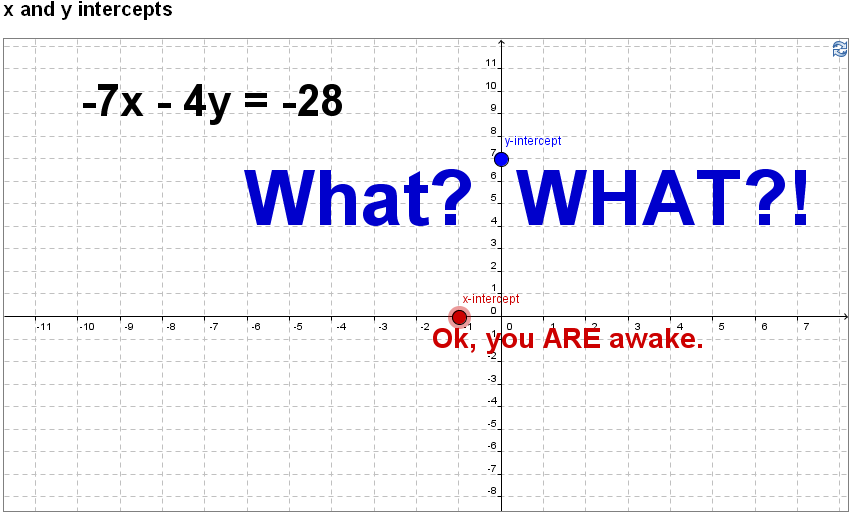
The Non-Khan Academy Un-Lecture Prompt  


Me:  Tell me what to do.

Them:  Put the red dot on ____ and the blue dot on _____.


Gentle Feedback for Misconceptions 


Encouragement 


Scaffolding


And Finally


Hit the refresh icon and Repeat


Exit Slip

7x - 3y = 21

x intercept: ______

y intercept: ______

Results

90% correct


 The applet.  (includes original .ggb file as well as jar files.)