Showing posts with label inquiry. Show all posts

Thursday, December 5, 2013

I Like Triangles

Last night, I asked if anyone could point me back to this fantastic animated factorization visualization. (h/t @calcdave)

Now, I'm kicking myself for not thinking to use this in the first weeks of the school year.  Talk about some Fake World math doing a number on pseudo engagement strategies.

I started the animation at the end of each period and walked out to greet students as they walked in.  Once everyone got settled, I walked back in the room and each time the dots would circle up, I'd yell, "PRIME!"

"Alright, I'm up 1-0. PRIME!, man I'm smoking you guys."

Kids caught on really quick and started looking for the circled numbers.  In fact, it took many students a while to realize that the applet literally said "prime."

We started out by looking at the patterns and how each number was represented visually.


But, next I said, "You know what, I really like triangles. What is the smallest number that will give us a triangle?"

This one's easy. 


"Alright, what's the next number that will give us nothing but triangles?  Write your guesses on your easel."

Guesses were about 50-50 between 6 and 9. 


"Alright, what about the next one?"  

Still guesses were a little sporadic.  But by the time we got to 81, most students thought they figured out a pattern.  From 243 on, we were at about 100%. 


After about 10 minutes of doing this and discussing our results, I put up this slide.


There was a nice discussion on clarifying our question.  Three different student offerings illustrated the idea of First Idea; Best Idea. 

Student 1:  At what stage is each triangle?

Student 2:  How many triangles are in the green circle?

Student 3:  How many dots are there in each circle?  *Boom*

Now get to it and be prepared to justify your answer.  

The first student said there were 9, 27, 81 and 243 dots.

"Ok, great. So how did you do that?"

"Well, the green circle has 9 dots, then I multiplied by 3 to get the red. Multiplied by 3 again to get the blue and then by 3 again to get the black."

"Alright, so let's press on this idea a little."

I know what question I want to ask, but I just bit my tongue until a student speaks up.

"How can you be sure that there are 9 dots in the green circle?"  *There it is*

"I estimated."

Here's where it gets good. 

 From across the room, I hear, "It looks like there are 9 dots in the green circle, but we have to look past that."

Wait, what?

"Yeah, we can't trust the picture because the dots are too small.  We know there are 6,561 dots on the whole page and there are three black circles of dots.  We have to start there."


So, Dave, keep this link handy, I'm sure I'll be asking for it again next year.  

Wednesday, October 5, 2011

The Un-Lecture

Pretest

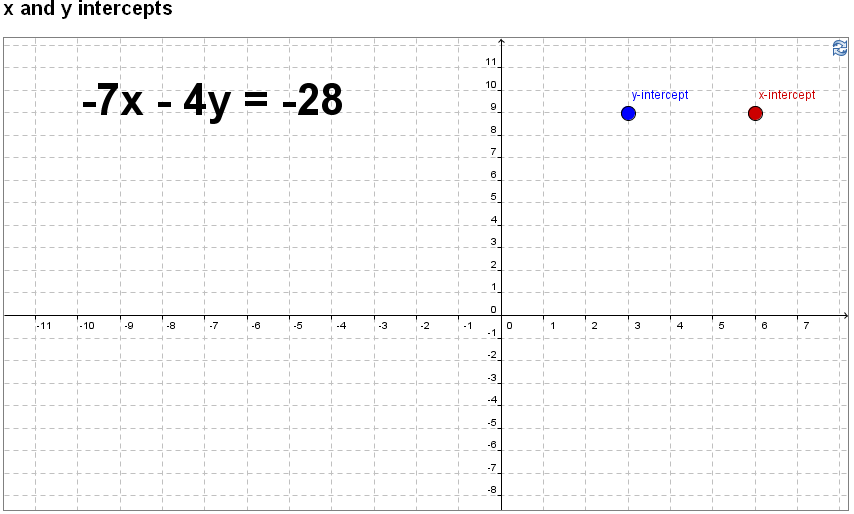
3x - 5y = 15

x intercept:  ______

y intercept:  ______


Results

0% correct


The Non-Khan Academy Un-Lecture Prompt  


Me:  Tell me what to do.

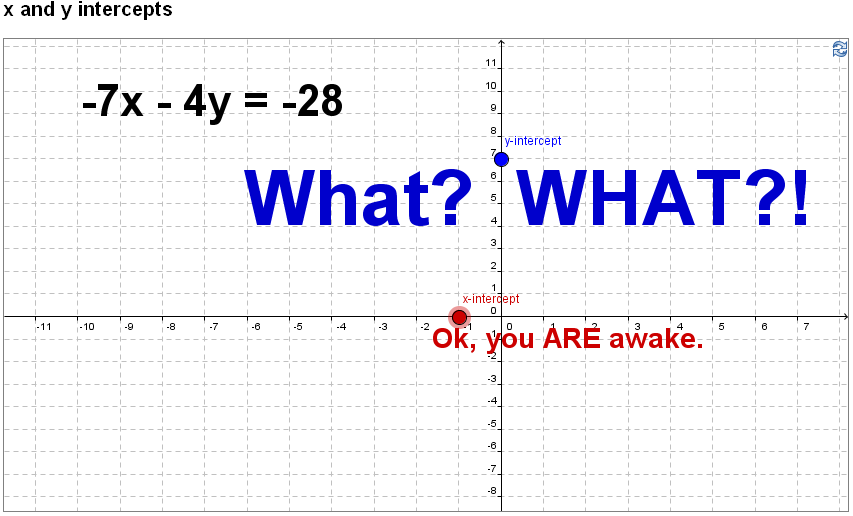
Them:  Put the red dot on ____ and the blue dot on _____.


Gentle Feedback for Misconceptions 


Encouragement 


Scaffolding


And Finally


Hit the refresh icon and Repeat


Exit Slip

7x - 3y = 21

x intercept: ______

y intercept: ______

Results

90% correct


 The applet.  (includes original .ggb file as well as jar files.)

Wednesday, July 27, 2011

Popping Popcorn in a Popcorn Popper


Popcorn Question from David Cox on Vimeo.

Most of my previous attempts with these story problems have resulted in me slapping on a timecode and cutting the video.  This one had me thinking a bit.  I'm not sure I got it.

Your assignment:

1.  What question does this provoke?

2.  If you have a tough time answering #1, what question do you think I was after?  And what can I do to help that question along?

Act 2's a Killer

I need a little help.  I think I've nailed the question:


Barbecue Q2 from David Cox on Vimeo.

But I can't figure out what to give students to help them through Act 2.

Here's the raw footage and the current conversation and Greg's run at the data.  (Thanks to @maxmathforum for archiving)

Any help would be appreciated.

Friday, May 27, 2011

And Now a Word From Elisabeth

Elisabeth decided to define her own project.  She became interested in the Golden Ratio.  She came to me with a boatload of questions she wanted to tackle ranging from: 1) How can I create the Golden Spiral? to 2) Why is the Golden Rectangle aesthetically pleasing?

I said, "yeah, that's some good stuff there.  I trust you.  Do it."

Two days later, I sit down with her as she's working and watch her think.  She has this perplexed look on her face as she is shuffling through her notes.  She has about a half-dozen different rectangles sketched with different dimensions along with more questions than what she started with.

She looks up and says, "The more I look through all this, I'm wondering, 'what's my question?'"

That's right, Elisabeth.  Don't ever forget that.

Thursday, May 26, 2011

Something Different

This year, I decided to take a much more hands-off approach when it came to student projects. There were some homeruns, but there were too many swings-and-misses. Some students opted not to even step to the plate. I suppose that's what happens when students are offered more autonomy. But, I didn't do enough to prepare them to make decisions in such an open ended environment. I think I was too hands-off.

For the final project, I gave my 8th graders seven choices; one of which was to determine the angle that would maximize the distance traveled by a projectile.

What they knew:
  • Linear motion model.
  • Vertical motion model.
What they didn't know:
  • Vertical and horizontal motion do not affect one another.
  • How vertical and horizontal motion work together to determine the path of a projectile.
  • Trig ratios

Last year I had students do an investigation on trig ratios prior to working with projectile motion. But due to a shortened school year and the fact that all of my students will be taking geometry next year, I had to cut something.

It took a few short conversations for the group to get the fact that horizontal and vertical work together to determine the path and that they needed to use the vertical motion model to determine how long the ball would be in the air. From there, they could figure out how far it would go.

But there was one problem: they didn't know how fast the ball was travelling which made it impossible to determine the vertical and horizontal components.

The Process

Q: How fast is the ball travelling when it is hit?
A: I didn't specify, did I?

This led to a nice conversation on how we need to eliminate as many variables as we can.


Solution: Pick a velocity and work with it. They chose 100 ft/sec.

Q: So how fast is the ball travelling vertically and how fast is it travelling horizontally?
A: That depends.
Q: On what?

So we took turns pushing Joey around the room from behind and the side simultaneously. Each time one person pushed harder than the other.


Conclusion: If the person from the back pushes harder, Joey goes forward more. If the person from the side pushes harder, Joey moves to his left more.

Then we talked about how the velocities can be modeled using vectors and we can use what we know about triangles. Since the forces are perpendicular, we have a right triangle.

Q: If all we know is the hypotenuse of the right triangle, how do we find the other lengths?
A: Is that really all you know?


Solution: They settled on using a 45-45-90 since that is the only way they could figure out the other two sides.

Q: But what do we do for other angles?
A: Yeah, that's kinda tough, huh? Why don't you use a protractor to draw the angle you want, build the triangle you want and measure.
Q: Can we use GeoGebra?
A: Or that.

They used an applet with a fixed hypotenuse of 100 and gathered data on the other two sides.

Q: Is there an easier way?
A: Yeah. It's called sine and cosine. See how these ratios don't change as long as the angle remains constant? (it took a little longer than that, but you get the point)

They were off and running.

Conclusions
  • 45 degrees maximizes distance.
  • Complementary angles yield the same distance.
  • Oh, and this:


I think you physics folks would say something like this:


Friday, May 6, 2011

Well, Since You Asked

I had a copy of John Van de Walle's book on my desk the other day when a student asks, "Mr. Cox, what are you reading?"

"Oh, this book on how to teach math.  It's pretty interesting."

"Oh, yeah?  What's so interesting about it?"

"Well, I like this chapter on Teaching Through Problem Solving.  It mentions three different ways problem solving can be taught:  Teaching for problem solving, Teaching about problem solving and Teaching through problem solving."

"What's the difference?"

"Well, teaching for problem solving is when students will learn a certain set of skills and then later be asked  to solve a problem using those skills.  Teaching about problem solving is when students learn about particular strategies for solving problems.  And teaching through problem solving is when students are given the problem first and then they figure out how they want to solve it.  It's kind of the opposite of teaching for problem solving."

"Hmm. So teaching for problem solving means the teacher shows us how to do stuff first?"

"Yeah, pretty much."

"They don't think we can think for ourselves?  That's kind of offensive."

Tuesday, April 19, 2011

Point of View

I can just sit and stare at both of these.

What (if any) questions do these provoke?


Saturday, March 26, 2011

I Made Me Do It

or Dave Made Dave Do It

or @calcdave and @dcox21 are pretty much the same person so this is really a post about a guy talking about himself to himself (or would that be to himself about himself?).

Whatever.

So apparently Dave was eaves dropping on one of my conversations (the nerve of some people) and started asking some interesting questions. I particularly liked the triangle image and couldn't help myself especially since Jason encouraged me via GoogleChat last night (or was it GoogleTalk?) to keep doing this GeoGebra stuff.

Oh, and Jason and I live in California (which makes us pretty much the same person too, except that he lives in the Bay Area and I live in the Central Valley so we are the same person kinda like Massachusetts and Texas are the same state in that they are both part of the contiguous United States) and he lives, like right next door to Dan who's been to Canada.

So I guess y'all have to thank Canada for this applet, eh.


This is a Java Applet created using GeoGebra from www.geogebra.org - it looks like you don't have Java installed, please go to www.java.com

Friday, December 17, 2010

Volume

We had a few presentations to watch due to absences and one in particular sparked a pretty good discussion. One, in particular, focused on how to find the volume of a cylinder.  The presenter told the class how to find the volume and then proceeded to explain why we find the volume of a cylinder by using the formula:

V = πr2h


But she didn't stop there.  She asked herself and the class:

Why is that the formula?

She went on to describe how it's like taking a bunch of CDs and stacking them.  We know we can find the area of a CD.


That's when things got interesting.  I heard comments like these:


  • We use the height to determine how many circles it takes to make up the cylinder. 
  • But it's just like a line [it has no height].  How do you get volume with that?
  • If you have a thing of CDs and stack them...you're going from 2D to 3D.
  • But area has no height.  We're stacking things that have no height. 
So we talked a little about finding the volume of a rectangular prism is just counting the number of cubic units it takes to fill the prism and how doing that with a cylinder is tough because its round.  I liked the direction they were going with this by trying to talk about something larger by defining it by its smaller parts.  So small, in fact, that the height is practically 0.  

I ask, So how can you find the volume of a sheet of paper?

A student takes a sheet of paper puts a ruler up to it as if he's going to measure the height of one sheet of paper and one of his group members says:

Dude, why don't we just make a stack that's 1" tall and divide by the number of sheets it took to make it?
They all agreed that would work and I thought we were ready to move on when a boy asks, "So what's the volume for a sphere?"

They wrestle with this for a minute or two when one of them turns to me and says, "Mr. Cox, you know, huh?"

Yep.  

But you're not going to tell us are  you?

Nope.  

A student opens his planner to the Math Formulas page and starts to tell us what the formula is when one says, 

I don't care what the formula is.  I want to know why that's the formula.

Next semester's gonna be fun.  

Thursday, December 16, 2010

Exterior Angles

"Hey, Mr. Cox.  Is there a theorem that says this?"


I'm not sure.  Why do you think that's true?

"Well if a triangle has 180o and I know two of them, then the third one has to be whatever's left over from 180o.  But that third angle and x make a straight line so they have to add up to 180o too."

If it's true, what would you call it?

"I remember seeing something about 'exterior angle' in the index one time, so that's taken.  Maybe I'll look it up and see what that one means."

*goes and looks up Exterior Angle Theorem*

"Ah, man!  Someone already discovered it."

Monday, June 21, 2010

Adventures in Pedagogy: Experiments

Homeschooling has been interesting.  Suffice it to say, my kids have developed some bad habits very quickly. It's hard to admit that I've let my own children become answer chasers right under my nose.  I ask questions and we have a lot of conversations, but in a typical school day, my kids are gone from 8:00am-3:30pm and then have busywork waste-of-time-packet-work, er, homework to do.  By the time they were done, there wasn't really any desire to talk about the hoops they were jumping through stuff they were learning.

This morning was fantastic.  Nevan, my 8-year-old, was stoked that he had a science experiment to do.  He was looking through his text and saw the experiments and just lit up when my wife told him we were actually going to do them.

"Mom, my book at school had all kinds of experiments, but we never got to do them."

Wait, what?

Now, I'm no science teacher, but I couldn't agree more with Shawn's assessment of the situation.

I think the look on this kid's face speaks for itself.

Friday, May 21, 2010

So Will It?

In my previous post, I described how we developed the Standard Form of a linear equation.  Students are already comfortable with using slope (rate of change) and the y-intercept (initial condition) to determine the equation of a line.  We are currently spending a lot of time recognizing the rule of 4 and how each representation simply tells the same story from a different perspective.  So, next I wanted to see what students would do with trying to decide whether or not a point is on a line.

Prompt:
Question:  Will the point go through the line?

Students made their guesses and we split the room into the two camps:  Yes and No. 

Cheaters were cast out!

Alright, I didn't really cast him out.  But we did have a short conversation
on how reliable the paper would be in determining whether or not the point is on the line. 

We need more information:
Not quite enough to determine slope intercept form, but enough to get a fairly good guess as to the slope of the line.  Students wrote their guesses for the equation and all groups came up with: 

y = -3/4 x + 4

Are you sure about this equation? 

Nah, we need a bit more information. 


Now we have both intercepts; enough to verify our slope and enough to write the equation in Standard Form.

But, do we have enough info to determine whether or not the point is on the line? 


So we verified two different ways: 

  1.  Continuing with the pattern determined by the slope.

  2.  Plugging the point into both equations to see if they are satisfied.

And finally:


The coolest part about this is that a colleague and I developed this lesson in about 10 minutes.  It's pretty rewarding when minds get together and focus on interesting ways to deliver instruction centered around a simple question.  Have to give credit to Dan for stoking the fire.

Thursday, May 20, 2010

Why Didn't I Think of This Before?

Now that we are finished with 7th grade standards, we start to take the concepts that are considered pre-algebra and stretch them into algebra.  My students have a solid understanding of slope as rate-of-change and I have been really emphasizing multiple representations.  They can handle an equation in slope-intercept form pretty well. 

I wanted to introduce them to standard form and have usually done this by giving the equation and having them graph.  In years past, I found many students really struggled with For some reason, I decided on a different approach this year.  This year I gave students the x and y intercepts and asked them if they could figure out an equation that would fit.  I introduced this equation as:

____ x + ____ y = ______

It became a puzzle and eventually kids nailed the idea that if we have the points (2, 0) and (0, 3), we can write the equation as: 3x + 2y = 6.  And after 5 or 6 examples, I gave them the points: (e, 0) and (0, f) to which they responded with: fx + ey = fe. 

Now, given the equation, can we find the x and y intercepts? 
Not a problem. 

The game play at the beginning of the lesson really opened them up to the idea which made any actual instruction I had to do much easier. 

In the end, I say it was a win.

Thursday, April 22, 2010

Standard Deviation

For those of you who have been reading a while, you know that I'm not the best lesson planner in the world.  My SmartBoard slides aren't always the best designed, although that's something I'd like to improve upon.  And I'm not that creative with activities.  But today, I realized that I'm pretty good at getting out of the way when some real inquiry shows up. 

My 7th graders just finished state testing yesterday and I wanted to help set the stage for what I'm going to expect from them next year as 8th graders.  The 7th grade curriculum is not much different than grades 2-6; it's very skill based.  My kids are very good duplicators, but I want them to become good applicators and eventually creators.  I explicitly said that to them today.  I want them to focus on representing their ideas as many ways as they can. 

Tom Henderson:
@mathpunk

Anyway, the theory goes that you don’t understand a mathematical concept until you understand it in TWO modalities. I do very well with visual knowledge, so my notes of understanding are full of color and pictures and mindmaps and arrows linking concepts, and I highlight the holy hell out of math books. However, I don’t believe I KNOW a concept until I can explain it verbally, because I can barely understand anything if someone just talks it at me.

First swipe is through my best modality, second swipe is through my worst modality. The whole “learning style” thing may be overstated, but it remains true that getting students to understand things in a variety of modalities seems like the way to go.

So today the plan was to:
  • Have a little chat re: expectations
  • Work through some pattern recognition via sequences
  • See if I can get them to describe the patterns at least two ways
  • Do an activity with algebra tiles
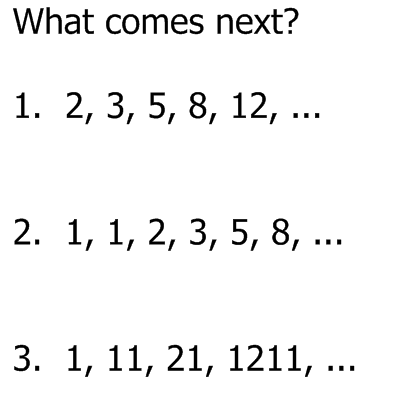
 Chat went well.  And I showed this slide:
Note: I'm pretty sure you get sequences 1 and 2, but just in case, sequence 3 has to do with words. The first term has one one (11), the second term as two ones (21) and so on.  So n5 = 111221.

Kids are really good at finding the next numbers but pretty lazy about writing a good description of the rule.  The had to add, "for example" to many of their written rules.  The challenge was to have them write a rule that was short but stood alone.  The got it. 

Challenge:  Can we write a rule in Mathanese?
I explained subscripts and how they can be used to name different values for the same variable.  For example: n5 represents the 5th term in the sequence. It didn't take long for them to recognize that:
n5 = n4 + n3

"So, if n5 = n4 + n3, what does nk equal?"

"nk = nj + ni."

This led to a great discussion on how the alphabet doesn't nec-ess-a-ri-ly have one to one correspondence with the whole numbers.  Good talk nonetheless. 

We ultimately settle on nk = nk-1 + nk-2 and for the most part the class was good with that.

Sequence three provoked something I hadn't considered before.  Luke asked if the fifth term could be 1231 or even 3112.  He explained:

"Each of the previous terms are describing what comes before it, but does it have to be as you read it left to right? Could it just be describing the amount of times the digit shows up in the term."

"So if I would have given you the fifth term, would your rule work?"

"Nope."

Then Joe comes out of nowhere.

"Are there more possible right answers?"

This is just too good to be true.  We now have two questions we need answered:
I let them choose which question interested them the most and split the class into two groups to investigate.  Group one came awful close to saying that nk = nk-1 + k - 1. They're not quite there so I'll let that one marinate for the night. Group two came to the conclusion that there were no other possible 5th terms. They were a bit disappointed because they thought that they got the wrong answer.

"No, no, no. You had a question. You investigated it. And you decided that the answer was no. Can you explain why the answer is no?"

"Yeah."

"Then that's a good day's work."


Gonna have to finish the algebra tiles tomorrow.